

Design workshop is a new series where I’ll share practical advice for aspiring graphic designers. Today, I’m talking about taste.
Discussions of taste have always felt a bit snobbish to me. I feel as if I’m in the chokehold of a turtleneck whenever I hear myself saying the word. Why? Because when people talk about taste, it’s often a preamble to an impassioned critique of the last work of art or design they consumed that gave them indigestion.
I think that’s a shame. The point of having taste isn’t to wield it like a hammer in clobbering anything that doesn’t measure up to your lofty standards, (as good as that sometimes feels) it’s really a practice of training your eyes and mind to savor the things you love. Its development brings a sense of deep satisfaction.
Aspiring designers should intentionally develop their taste, preferences, and visual style–not only because it will make them more successful, but because it’s fun.
The following are three simple ways to get started.
Collect
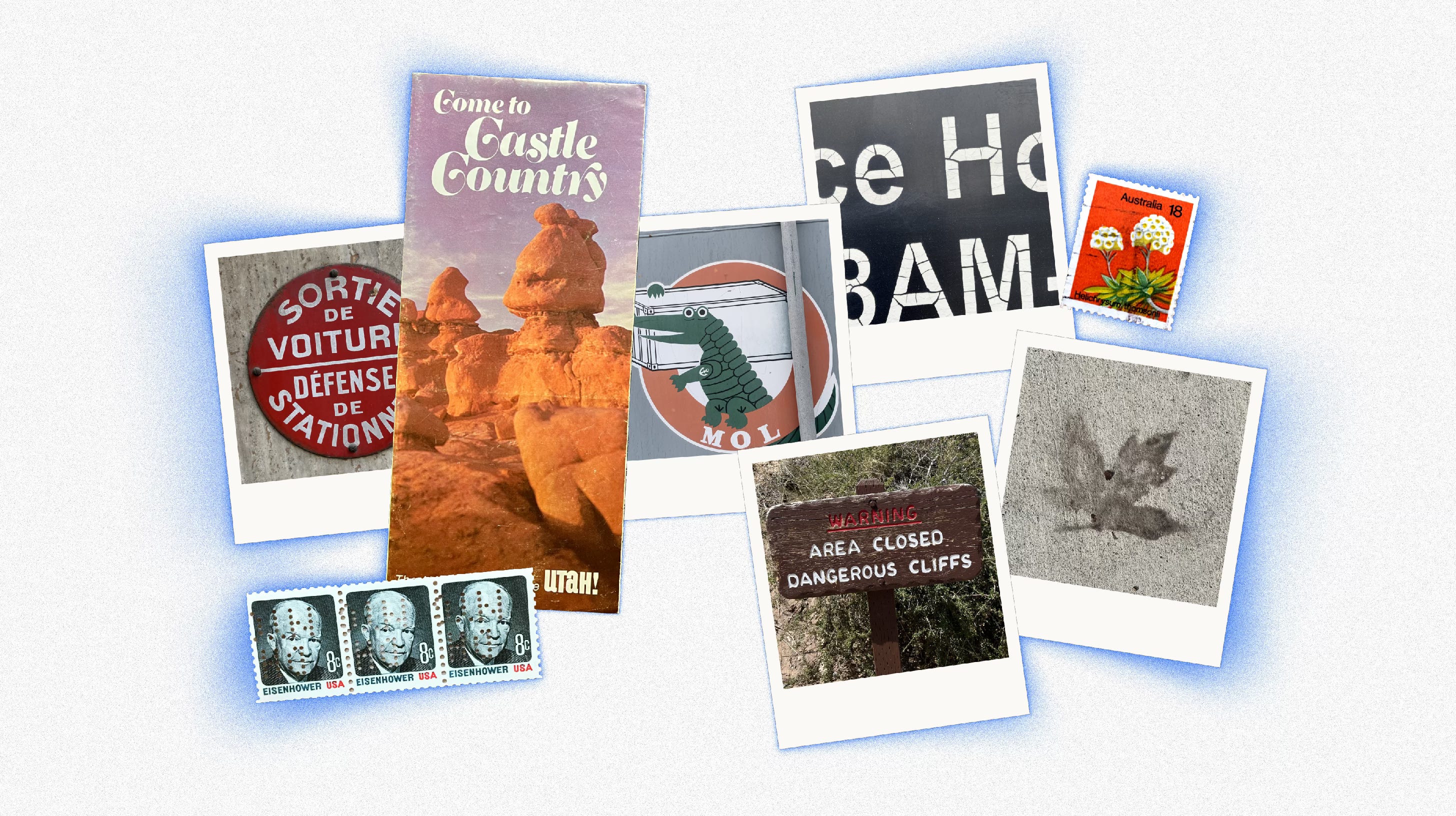
Be present, pay attention, and collect what you’re drawn to. One of my college professors called this filling the well. Inspiration is everywhere if you’re looking for it. A few examples of things I’ve photographed: the imprint of leaves on pavement, especially striking cloud formations, vintage maps and pamphlets, peeling and cracking vinyl letters, shipping container logos, and vanity license plates, to name a few.
Curate
Over time, you’ll notice patterns, themes, and subjects that come up again and again. Once aware of this, you can start pulling the strings to explore them further and even organize your collections for easy reference and later use. Whether or not you use any of it directly in your work isn’t so important. You’re training your eye and developing your own visual language.
Create
Now that you have a well of resources you can draw from, you have all the raw elements to create something new. How you remix and repurpose these sources is what will make them your own—this is where the magic happens. It doesn’t always feel like magic, mostly it’s trying as many things as you can think of and seeing what sticks. Once you’ve explored as many ideas as time and resources allow, you’re ready to edit, refine, and complete your project.
“The artist has to be something like a whale swimming with his mouth wide open, absorbing everything until he has what he really needs.”
—Romare Bearden
Starting out, you’ll imitate a lot. That’s fine, don’t fight it. Shamelessly copy the greats and learn to work in the style of others. If you don’t do this you’ll never find your own style.
What you’re drawn to will naturally become a part of your work, a sort of signature. Some folks seem to be born with an innate sense of style, a refined taste. Not me; I admittedly cringe when looking back at my early logo designs. We all have to start somewhere, just don’t stop there. Keep making things. The quality will come as you increase the quantity of your work.
A designer who finds inspiration for their work in design only is a bit like a snake eating its own tail. Your work will feel like everyone else’s. Find inspiration in books, art, architecture, films, plays, fashion, nature, and so on and so forth. You get the idea. A designer can’t live by Pinterest alone.
This collect, curate, and create cycle is a process that lasts your whole career, but it’s also repeated in miniature on every project. We research and collect at the beginning of a project. Then we curate the things that feel right out of all the exploration. And lastly, we synthesize all this knowledge, inspiration, and work into something new.
The longer you keep up this practice, the less daunting each new project will become, and eventually you’ll develop a sense of ease and confidence in your design process—whether you’re designing a resume or a brand identity.